In most agencies, data exists everywhere, from project management tools to accounting systems, spreadsheets and emails. Despite this, the majority of agencies don’t genuinely see their data. They might have a few dashboards across different platforms, but not a solution that transforms their data into meaningful insights that drive real business decision making.
As agencies grow, this lack of visibility becomes one of the biggest barriers to scale. You can’t improve what you can’t see. And you can’t grow sustainably when blind spots exist across your clients, projects, people, and profitability.
Agencies that prioritise data visibility grow faster, run smoother, and reduce risk/uncertainty for management.
Data visibility isn’t about creating a few new dashboards, it’s the ability for all your team to access and understand meaningful insights.
Put simply:
Data visibility is about giving the right people the insights they need at the right time.
In most agencies, this cover a few layers:
For agencies, this is especially challenging because work is project-based, service delivery varies from client to client, and teams typically use many different tools to get the job done. As a result, data ends up fragmented, duplicated, or lost entirely.
Agencies often grow by saying yes to new clients, new services, new tools, new deliverables. But without visibility into margins, capacity, and real delivery cost, you’ll find yourself running on gut instinct a lot of the time.
When you can clearly see:
you’re able to make decisions that support sustainable and strategic scaling, rather than accidental expansion.
Nothing builds trust like transparency. Agencies with strong visibility are able to:
Clients will feel the difference, and feel confident in trusting you to deliver larger contracts.
In our recent article on future-proofing for agencies, we explored how rapidly the industry is evolving. Data visibility is what allows an agency to adapt confidently, spotting changes in workload, client behaviour, or demand early enough to respond strategically rather than reactively.
The most successful, high-performing agencies share a few consistent habits when it comes to data:
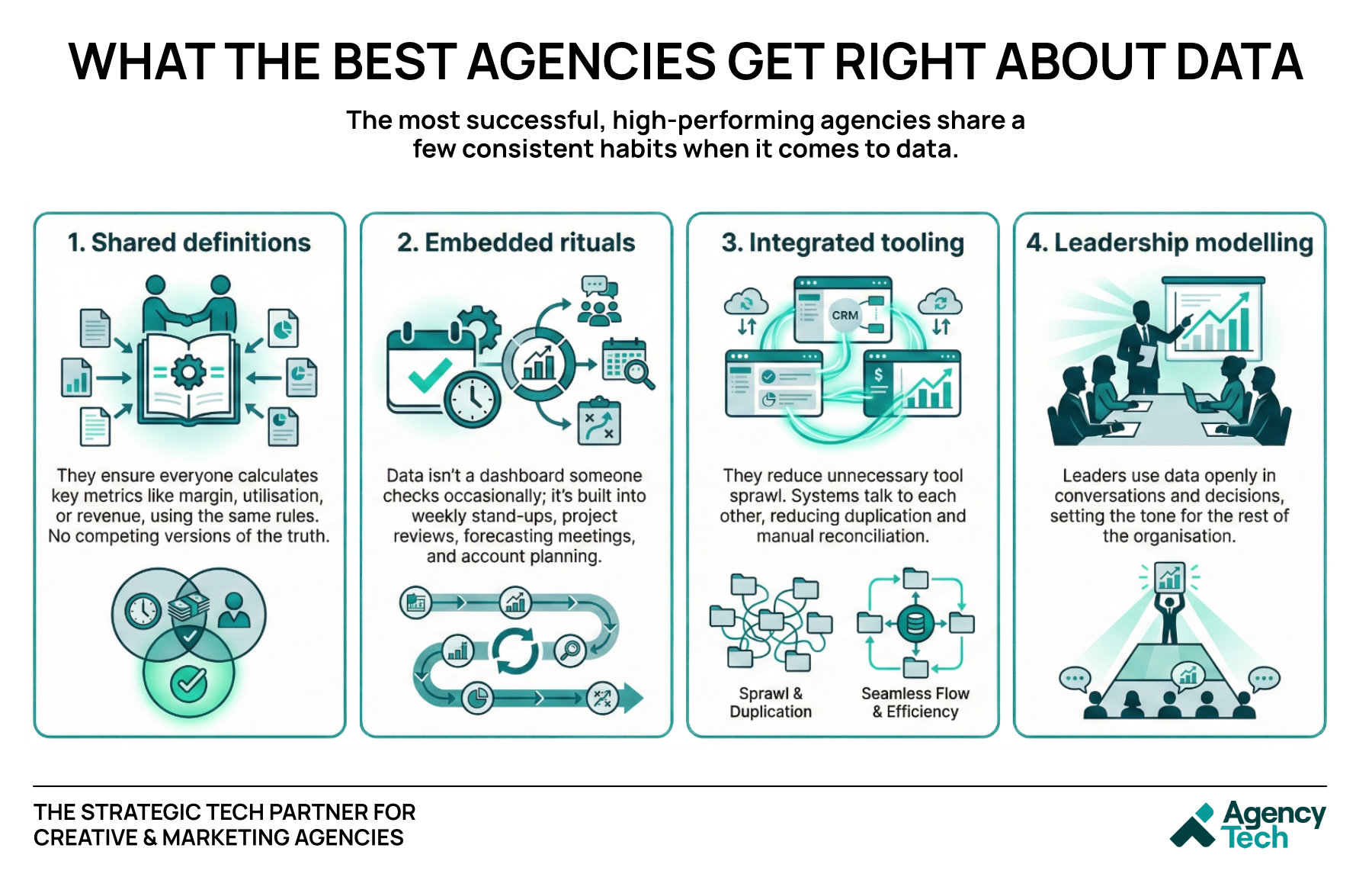
They ensure everyone calculates key metrics like margin, utilisation, or revenue, using the same rules. No competing versions of the truth.
Data isn’t a dashboard someone checks occasionally; it’s built into weekly stand-ups, project reviews, forecasting meetings, and account planning.
They reduce unnecessary tool sprawl. Systems talk to each other, reducing duplication and manual reconciliation.
Leaders use data openly in conversations and decisions, setting the tone for the rest of the organisation.
These simple principles dramatically increase adoption and impact.
Most agencies don’t lack data, they lack accessible data that can actually be presented to their team in a meaningful and actionable format.
The most common blockers we see are:
At AgencyTech, we work with creative and marketing agencies to help them modernise, integrate and future-proof their tech. We focus on the most impactful changes first, to make our services cost-effective and maximise ROI even for small teams.
Data visibility enables you to scale confidently, deliver better results to clients and improve operational efficiency. It’s not just about improving profitability, but creating a culture that embraces continuous improvement and data-driven work.
The agencies with the best profitability and happiest teams won’t be the ones with the most tools, they’ll be the ones with the clearest view of what’s actually happening inside the business.
If you’re ready to start making your data work for you, let’s talk.