Agency leaders we speak with don’t dismiss AI. They the concerns but they’re genuinely interested. They’ve seen the demos, read the articles, maybe started experimenting with a few tools. The problem isn’t awareness; it’s knowing what to do with it.
That gap between interest in AI and using AI well is a lot wider than you think and it’s costing agencies more than they realise. After speaking with creative and marketing agencies of all sizes, a few patterns come up almost every time:
Tools aren’t talking to each other. Teams are using a mix of platforms that have never been properly connected, which means data gets duplicated, context gets lost, and people end up doing manually what should happen automatically.
Rarely have people had proper AI training. Maybe some light prompting background here or there. There’s one or two people who have gone deep on it themselves but there’s no shared baseline across the team, no common understanding of how to prompt well, what to use AI for, or what good output looks like. Everyone’s reinventing the wheel every time they open ChatGPT / Claude / Gemini / Whatever LLM they’ve spun the wheel on that day.
There’s no governance or guardrails. AI tools have crept in informally, but there’s no company-wide approach, no policy, and often no clarity on something that matters a lot: where is your data actually going?
One 12-person agency we worked with was spending roughly two hours per person, per week, on follow-up notes and task setting after client calls. It was all being done manually. We put in a simple automation to handle it - and that’s now almost 100 hours a month back across the company. This isn’t a radical AI transformation. It’s a straightforward fix to something that should never have been a manual job in the first place.
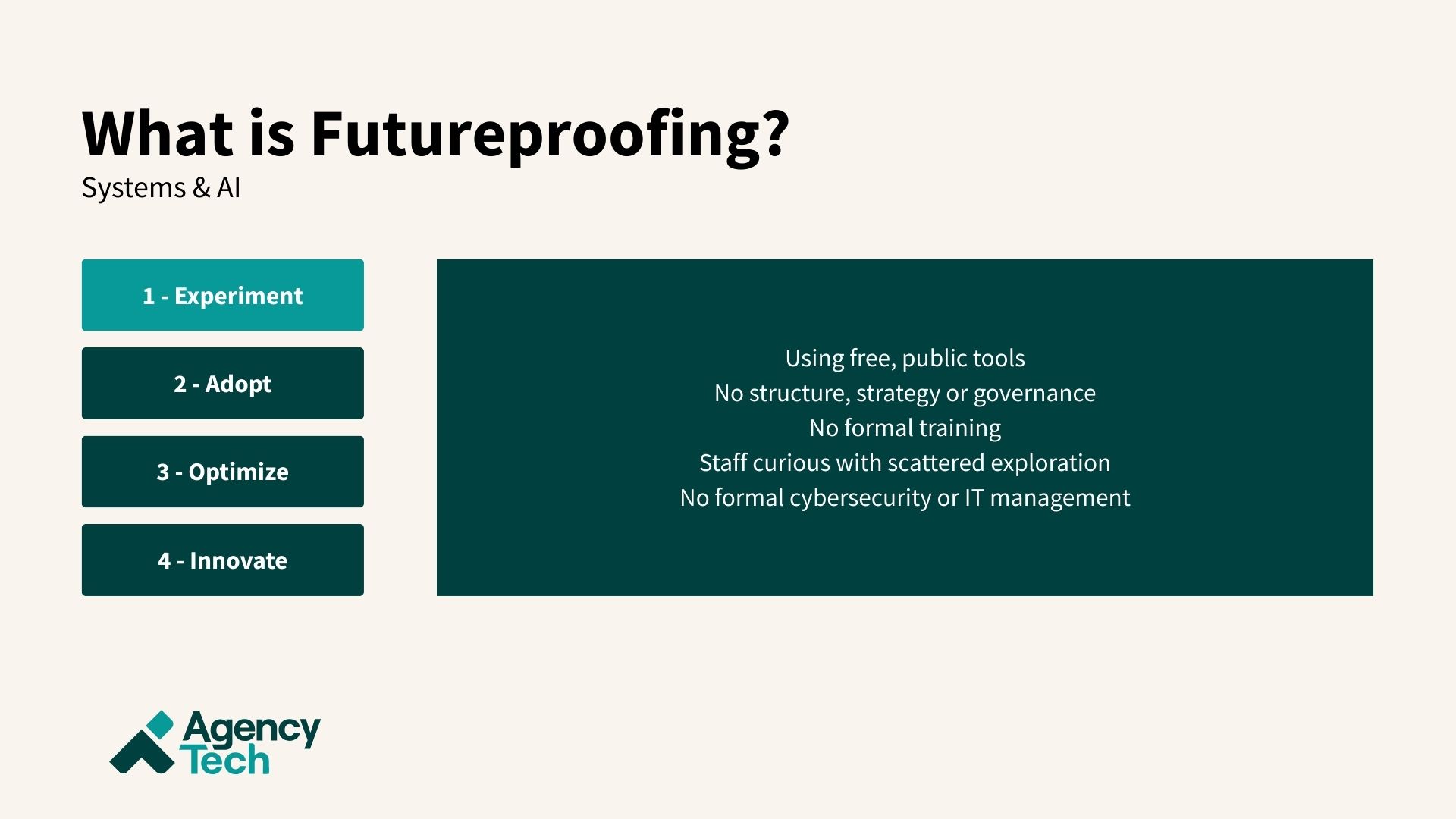
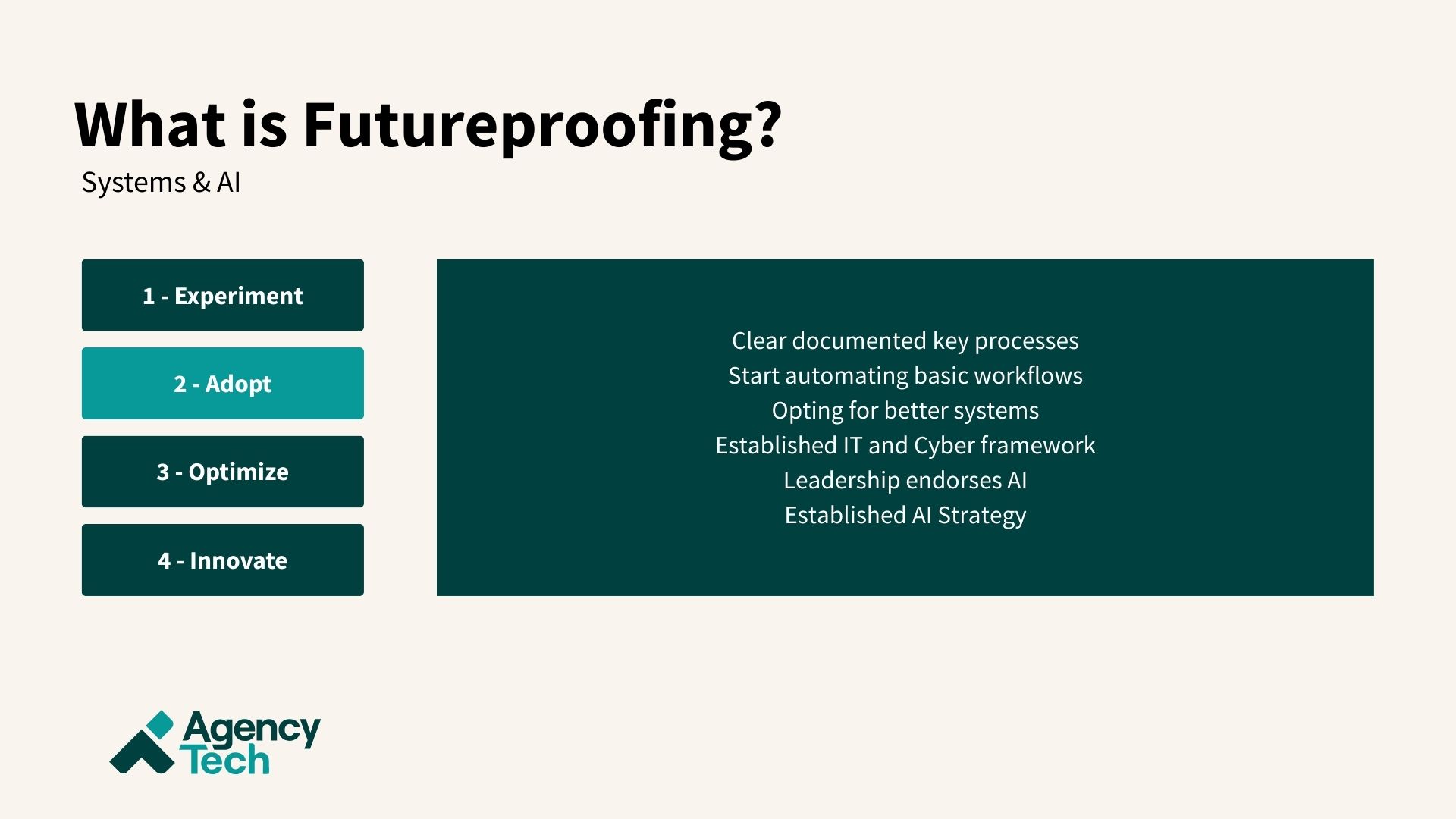
Most agencies rush into this brandishing weapons of enthusiasm and open mindedness. But so often we see teams getting excited, deciding to have a sprint around new tools, roll things out quickly and then stop using them after a month.
It feels like progress but it isn’t. The agencies that get the most from AI are the ones that have taken the first steps to understand where they are, what potential exists, where AI is most valuable, and have understood how, as a team, they work so they can amplify what they do well. So much of what makes agencies a unique industry, is the huge influence that individuals in the team, have on the overall style and process of
They bring in AI deliberately to do the heavy lifting in a system that’s already working, not to prop one up that isn’t.
A lot of what makes AI work inside an agency isn’t how good the model is or what incredible automation you set up. It’s the foundations underneath it.
Get the foundations in place, and you can build an engine that will help amplify what you’re already doing, not replace it, no matter what tools you’re using.
Here are three things that come up again and again in our work, things any agency leader can act on now.
We’re building a tool to help with this - watch this space.
Before anything else, establish where your team is with this.
You’ll be surprised at the results, often more uneven than leadership assumes. Some people are clearly doing impressive things; others are completely disengaged. There’s no right or wrong way but building a coherent approach without knowing where everyone is is difficult. AI adoption is like any other tool. Your team needs to buy into it, build it with them, and it’ll be more effective.
Set up a dedicated chat specifically for AI wins (or any wins if you don’t already have one!) When someone finds a prompt that saves them an hour, or figures out a better way to use a tool, they share it there. This creates momentum, surfaces what’s actually working, and stops good ideas from dying in someone’s personal workflow. Most agencies don’t have this. The channel itself also becomes an informal record of what your team is learning.
(Be careful making “I-messed-up/non-wins channel; that did not help team morale and was a mistake for my early days as a CEO)
We often see this as financial reconciliation or invoicing. Map the process, every step, of what needs to be done. Consider who’s involved in it, where the time goes, and how long it takes. One shared doc and a quick conversation are enough. Once it’s mapped it’s usually obvious where the time is being lost. This isn’t just AI; this is just good processes and that’s the point we’re making. A lot of the time AI is a gateway to actually look at how your company runs. This is why we’re so insistent on knowledge bases for our clients that we help build out and process reviews to actually get the key things processed and mapped.
One automation we love: every sales call gets automatically reviewed and summarised, and structured feedback is sent directly to the person who ran the call - based on the agency’s own internal documentation and good sales practice.
It’s specific, consistent, and arrives without anyone having to think about it.
This kind of result isn’t from a flashy new AI tool. It comes from taking something that’s already happening and building a better simple system around it.
There are also tools that transform how people work day to day. Granola and Wispr Flow are two worth knowing about, particularly for people who spend a lot of time in meetings or writing. They’re not complicated to set up, and the time saving is immediate.
We mentioned it already but one of the highest-level things we constantly are developing for agencies is a proper internal knowledge base. Agencies carry an enormous amount of valuable knowledge that slips through your fingers. In people’s heads, in email threads, in documents nobody can find. When that knowledge is structured and accessible, your team and AI can actually use it and you can start building towards a single source of truth for your company.
We developed these for our own companies and for clients. It also means, critically, when someone leaves, the knowledge doesn’t leave with them. And most interestingly, in developing this, it forces you to look closely at your systems, leading to unprecedented ideas for improvements.
The point isn’t to add more tools. It’s to build the foundations that make any tool work better.
The agencies that feel most confident about AI (the ones not lying awake at 3am wondering what it means for their business) are the ones that have a plan.
They know what they want to change and in what order. They’re running experiments deliberately, sharing all that works and building on it steadily. Not getting excited about something new every few weeks and losing momentum.
I’m the kind of founder that gets excited by shiny new things every once in a while, and I’m lucky to have a team around me and a co-founder, Ishaan, who reminds me that no, stick with something, do it properly, plan it out, and follow it through, and then move on to the next thing. AI doesn’t change the way people work and how humans think. It’s just another tool at the end of the day.
The foundation is everything:
If you’re not sure where your agency sits, that’s the right question to be asking. Most teams are further along than they think in some areas and have straightforward gaps in others. Knowing which is which is where it starts.
Casey Sather is co-founder of AgencyTech, the strategic tech partner for creative and marketing agencies. If you’d like to understand where your agency sits, we offer a free introductory call with no obligation.