AgencyTech Logo

Case Study

Reclaimed 4hrs/week per employee through company-wide AI rollout

Client

Design & Marketing Agency

Size

60+ staff

Completed

2025
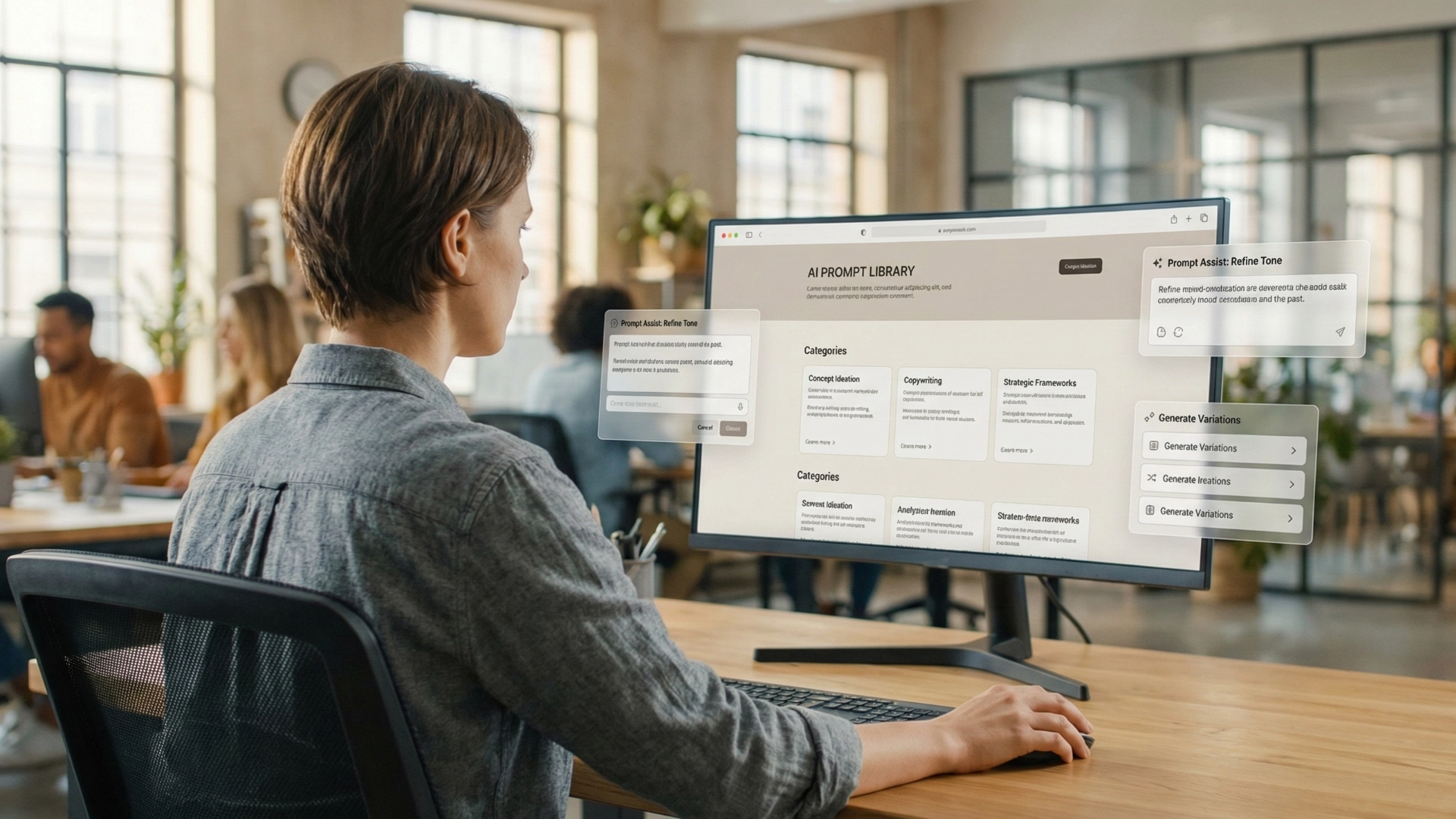
An employee interacting with an AI chatbot on their computer

Client Overview

A medium-sized design and social media agency, based in Bristol, wanted to move beyond ad-hoc AI use and make AI a safe, consistent, team-wide capability (not just an “individual experimentation” tool).

The Challenge

Before AgencyTech’s rollout, AI usage was unstructured and inconsistent:

  • No shared training, playbooks, or knowledge-sharing: people weren’t sharing prompts, didn’t know what “good” looked like, and kept recreating the same prompts through trial-and-error.
  • Governance uncertainty: concerns around hallucinations, IP, where data goes, and what is/isn’t safe for client work created hesitation-especially for senior creatives handling sensitive details.
  • Infrastructure wasn’t AI-ready: files lived in highly shared Google folders rather than a properly governed shared drive setup, limiting integrations and creating uncertainty around access control and future automation.
  • Innovation lag: turnaround wasn’t improving because workflows weren’t designed to take advantage of AI-teams felt they were “leaving efficiency on the table.”

As one team member put it, “the problem is it’s in everybody’s heads”-knowledge existed, but it wasn’t captured in a repeatable system.

Our Approach

AgencyTech delivered a structured rollout designed for adoption + governance + future-proofing:

  1. Discovery / Audit

    Mapped how teams currently worked, where AI could remove friction, and what leadership needed to feel confident around risk, policy, and change management.

  2. Data & File Restructure (AI-ready foundations)

    Transitioned away from ad-hoc shared folders toward a more robust shared cloud structure with:

    • clear ownership and access rights
    • sensible structure for retrieval and re-use
    • guardrails that support future automation and integrations
  3. AI Rollout (tooling + behaviour change)

    Introduced ChatGPT and aligned it to how individuals prefer to communicate and work-so adoption wasn’t theoretical, it was practical and personal.

  4. Training Seminar + Follow-up Materials

    Delivered a company-wide session (most of the 60-person team attended), backed by digital documentation for ongoing reference-ensuring learning didn’t disappear after one workshop.

  5. Follow-up Support (1:1 enablement + integrations)

    Continued support after training through 1:1 sessions and custom GPT integrations, helping roles translate AI into repeatable workflows (not just faster “drafting”).

  6. Systems Blockers → SLT Feedback Loop

    Identified wider workflow and system constraints and fed them back to SLT/directors to unlock longer-term productivity gains.

The Solution

A practical, governed AI enablement program combining:

  • AI-ready cloud infrastructure (shared drive strategy, access control, guardrails)
  • Organisation-wide onboarding to ChatGPT with personalised usage patterns
  • Training + documentation to standardise prompting, reduce rework, and build confidence
  • Custom GPT workflows for repetitive tasks and role-specific accelerators
  • Clear guidance on safe use (human-in-the-loop, checking, and client-safe practices)

The Results

Based on the post-training survey (16 responses) the team reported measurable improvements:

Time saved

  • Reported savings ranged from 1–10 hours per week
  • Average: ~4 hours/week saved per person (median 3.5 hours/week)

Confidence and capability (average /10)

  • AI Literacy & Safety: 8.5
  • Prompting effectively: 7.7
  • Comfort using AI for public assets (with human review): 7.3

Practical workflow outcomes (most common positives)

  • Faster first drafts for captions, emails, and client comms
  • More creative variety and stronger first passes
  • Fewer preventable mistakes (links, names, typos) through AI-assisted QA
  • Cleaner data/reporting and less manual admin
  • Early momentum on Custom GPTs for repeatable tasks (briefing, SEO metadata, reporting)

Key Takeaways

We helped the agency turn AI from “random experimentation” into a governed, repeatable capability-unlocking ~4 hours/week per person while improving confidence, consistency, and readiness for automation.